
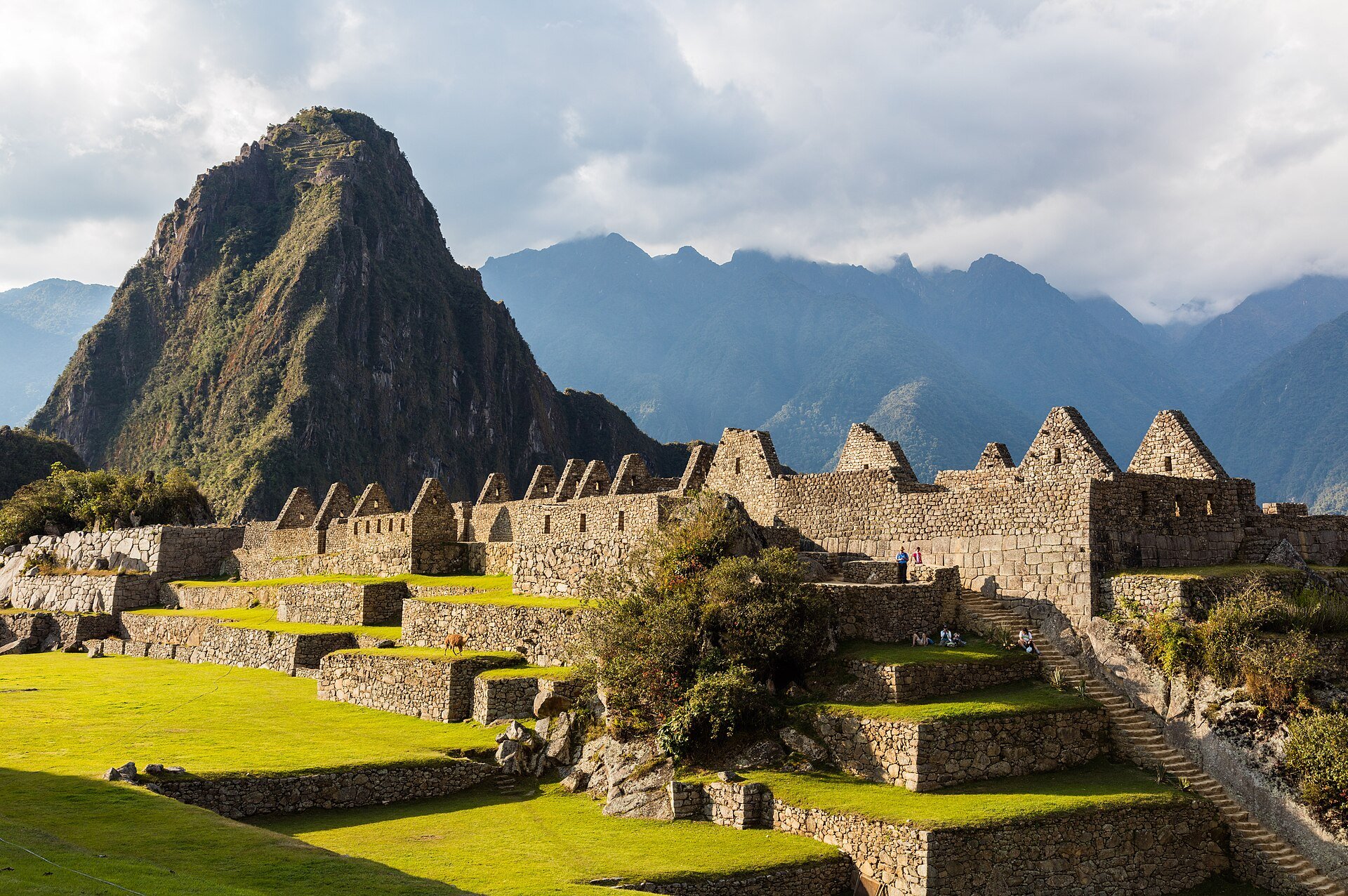
Nobody knows why this city was built. Machu Picchu holds more than 150 stone buildings on a Peruvian ridge — temples, storehouses, houses, terraces — raised with no mortar, no iron, and no wheels. Its holiest stone was carved to tie down the sun. It was abandoned before it was ever finished. And the Spanish took an empire — and never found it.
Watch the investigation
The Machu Picchu Short — "The City the Conquerors Never Found!" — is live on the channel.
Watch on YouTubeStones that dance in earthquakes
Run a knife along the city's best walls and you'll hit a problem: there's nowhere for the blade to go. The Inca cut their stones to fit each other so precisely that the joints are hairlines — no mortar, just stone kissing stone. And that precision is why the city still stands. In an earthquake, the mortar-free walls move — they dance — then settle back exactly as they were. Trapezoidal doorways, walls that lean inward, terraces buttressing the slope: the whole city is built to ride out the Andes shaking beneath it.
Key facts — Case File #076
- The place: Machu Picchu, Peru — an Inca citadel of 150+ stone buildings.
- The build: no mortar, no iron, no wheels — multi-ton blocks moved with ropes, levers, and human muscle.
- The joints: stones fit so tight a knife can't pass — and the walls dance in earthquakes, then resettle.
- The sun stone: the Intihuatana, carved from living bedrock to tie the sun down; at midday on the equinoxes the sun stands almost directly over it.
- The mystery: abandoned before it was finished — colossal blocks still sit in the quarry, never set into a wall.
- The vanishing act: three centuries of Spanish rule, and no record of it. The outside world met it in 1911.
The stone that ties down the sun
At the city's high point stands the Intihuatana — the "hitching post of the sun." It wasn't placed there; it was carved directly out of the living bedrock. At midday on the equinoxes, the sun stands almost over the pillar, and the Inca believed the stone held the sun in its place along its path — a rope of rock tying the sun down. Spanish iconoclasts smashed intihuatanas all over the empire. This one survived untouched, for the simplest of reasons: the Spanish never reached it. Visitors still file past to hold their hands near it and swear it hums with the energy of the sun.
Abandoned mid-sentence — and never found
The case closes on two silences. First, the city's own: it was abandoned before it was finished. In the quarry, colossal blocks lie cut and waiting, never set into any wall; structures stand with work stopped mid-course, a city interrupted mid-sentence. Then the louder silence: across three centuries of conquest and colonization, Machu Picchu appears in no Spanish record at all. The empire fell city by city — and this one, one of its wonders, wasn't in any of them. Whatever the city was for, its secret kept until 1911. Royal estate, temple, or observatory? The file stays open.
Frequently asked questions
Why was Machu Picchu built?
Nobody knows. More than 575 years on, its purpose is still an open argument — royal estate, temple, observatory: all have evidence, none has proof.
How do Machu Picchu's walls survive earthquakes?
The stones are cut to fit without mortar, so precisely that a knife blade can't pass between them — and in an earthquake the walls move, or "dance," then resettle as they were.
Did the Spanish find Machu Picchu?
Never. Across three centuries of conquest and colonization, the citadel appears in no Spanish record. The outside world met it only in 1911, with Hiram Bingham.
Keep exploring
- 🐍 Chichen Itza: The Pyramid That Is a Calendar of Stone — another city built to keep time with the sky
- 🏛️ Baalbek — stones even Rome couldn't explain
- 🌊 Lake Baikal: The Deepest Lake on Earth