
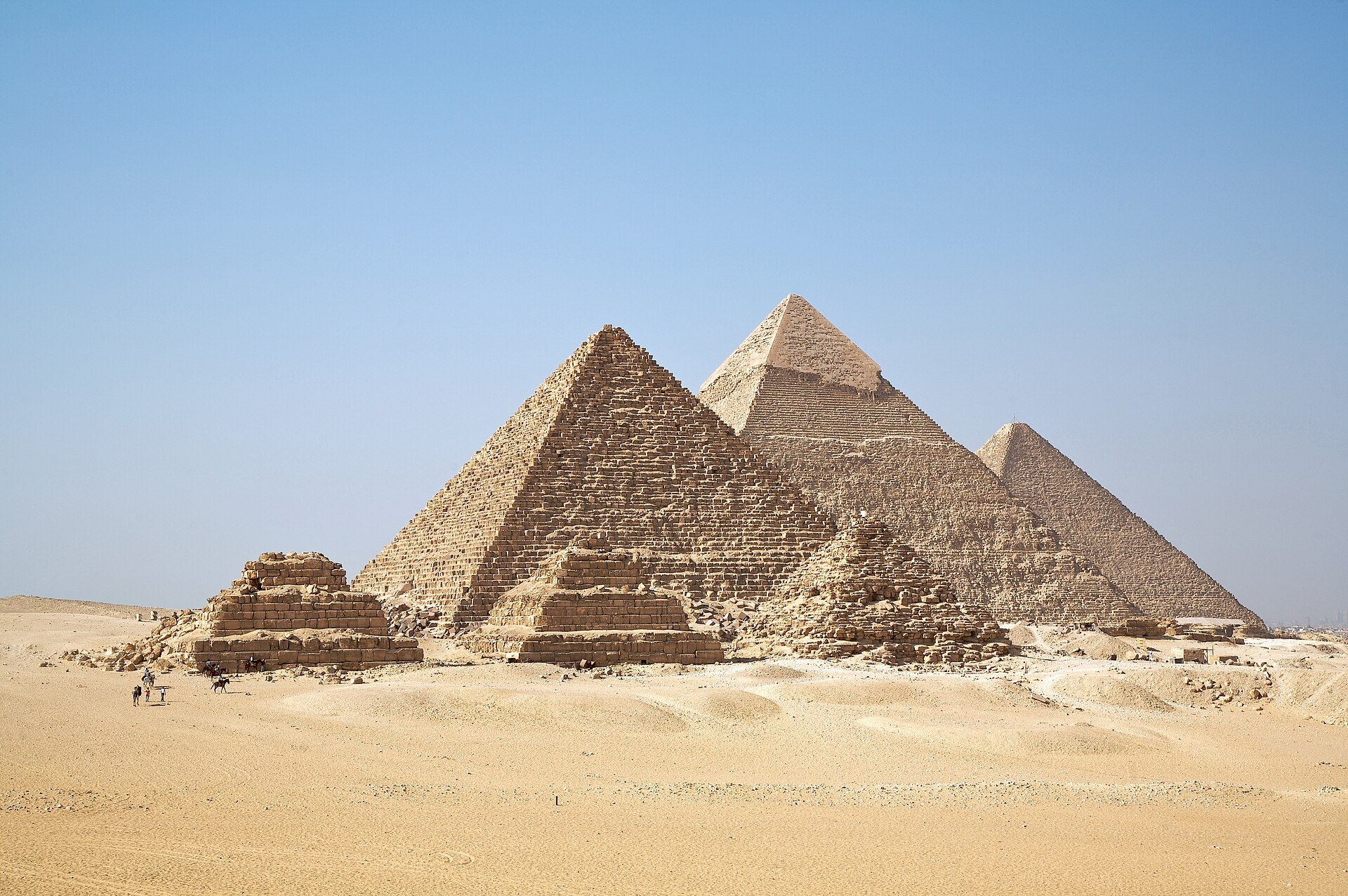
Two point three million stones — and they point true north. The Great Pyramid of Giza was raised for the pharaoh Khufu around 2600 BC, and it held the title of tallest human-made structure on Earth for roughly 3,800 years. But the number that opens this case file isn't the height or the weight. It's the aim: the pyramid's sides line up with the cardinal directions to within fractions of a degree, set by builders working with copper tools and the night sky.
Watch the investigation
The Giza Short — "2.3 Million Stones… And They Point TRUE NORTH?!" — is live on the channel.
Watch on YouTubeTallest for 3,800 years
Start with the scale, because the scale is absurd. Around 2.3 million stone blocks, roughly 5.75 million tonnes in total, stacked to an original height of about 481 feet. The workforce that built it worked for about twenty-six years — and then, for the next thirty-eight centuries, nothing human beings built anywhere on Earth stood taller. The record finally fell in 1311, to the spire of Lincoln Cathedral in England. One Egyptian tomb out-tallied every cathedral, castle, and tower of the ancient and medieval worlds combined.
Key facts — Case File #027
- The place: the Great Pyramid of Giza, Egypt — built for the pharaoh Khufu, c. 2600 BC.
- The stones: about 2.3 million blocks, roughly 5.75 million tonnes total.
- The record: tallest human-made structure on Earth for some 3,800 years, until 1311.
- The aim: sides aligned to the cardinal directions within fractions of a degree.
- The open question: there is still no definite consensus on exactly how it was built.
Aimed at the stars
Now the twist this case is really about. A pyramid that big could have been pointed anywhere — nobody would have blamed the builders for a few degrees of wobble. Instead, its four sides track north, south, east, and west with an accuracy modern surveyors measure in fractions of a degree. The leading explanation is patient astronomy: watch two stars circle the pole, split the difference, and you have true north. No compass — the compass wouldn't exist for thousands of years. Just sky, string, and care.
And the biggest question is still open. Ramps, levers, water, sledges — how exactly 2.3 million blocks climbed into place remains genuinely unsettled, with no definite consensus among the people who study it. The most measured building of the ancient world keeps its method to itself. That's not a gap in the file. That IS the file.
Frequently asked questions
How many stones are in the Great Pyramid?
About 2.3 million blocks, adding up to roughly 5.75 million tonnes of stone. It was raised for the pharaoh Khufu around 2600 BC, in about 26 years.
How accurately is the Great Pyramid aligned?
Its sides line up with the cardinal directions — true north included — to within fractions of a degree. The builders achieved that with Bronze Age tools, most likely by watching the stars.
How long was the Great Pyramid the tallest building on Earth?
Around 3,800 years — longer than any structure before or since. At about 481 feet tall, it was not passed until Lincoln Cathedral in England, in 1311.
Keep exploring
- 🛕 Kailasa Temple: The Temple Carved From One Rock — the builders who carved DOWN instead
- 🏛️ Baalbek: The 800-Ton Stones Nobody Can Explain
- 🌀 The Lost Labyrinth of Egypt: 3,000 Rooms Still Missing